
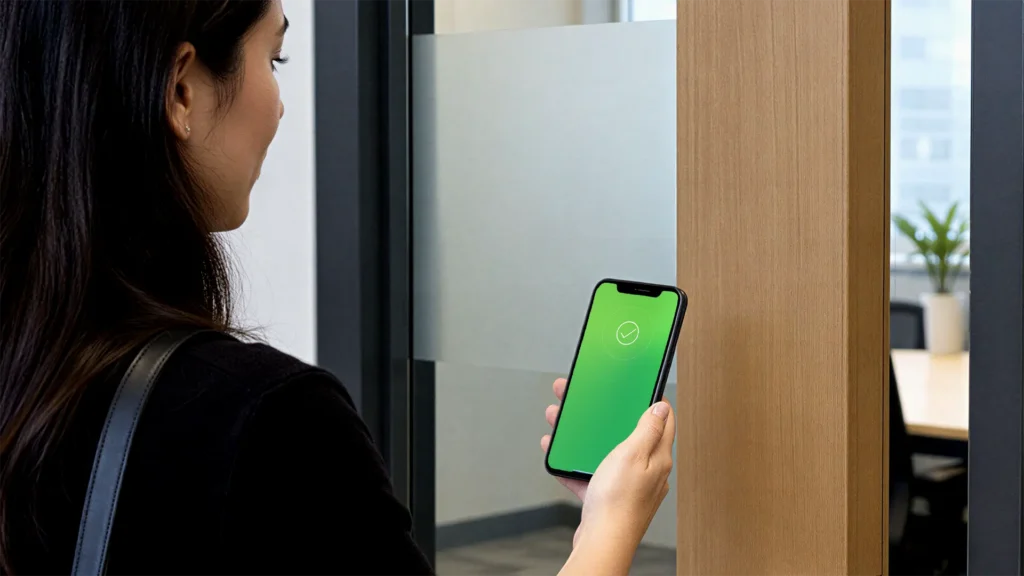
Organizations across industries looking to modernize their access control architecture and move to a mobile access solution usually face a trade off. They are faced with the costs and disruption of replacing their current reader hardware for new mobile-compatible reader hardware necessary for the mobile credentials they wish to issue to their users.
This migration to mobile credentials can take months to implement and can become very costly for small to medium sized businesses, when all they are looking to do is modernize building access, shifting from physical cards to mobile credentials, to enhance user experience and improve identity and authentication security for users accessing their space.
Why not simply enhance access control architecture rather than replace it?
Nowadays, there’s no need to make any changes to system infrastructure to gain mobile access capacity. There is now a software overlay for existing systems that can provide NFC mobile credentials for access control without any dependence on new hardware, so current access control panels and readers can stay just as they are. One example of a software overlay is readerless mobile credential software, this can be added to existing physical access control systems (PACS), and even the operational management systems that a business is already running. How is this possible you may ask? The software is built with open architecture and is secured with asymmetric cryptography making it interoperable and flexible to embed with multiple systems.
This article looks at how a mobile credential software layer built for interoperability with existing PACS architecture delivers the benefits associated with NFC mobile access, while protecting the hardware investments already made.
Where this plays out across industries
Coworking spaces run on tight margins and high member expectations. Members want the convenience of being able to access their space using their mobile phone, not carry another card, but a coworking operator managing several floors or locations can’t justify swapping out every reader to offer this premium feature.
Multi-tenanted buildings often have access control that predates the current property manager entirely, installed by a prior owner or a legacy vendor. Tenants rotate, leases turn over, and the building still needs a credential system that can keep up without a capital project attached to it.
Gyms and fitness studios live and die by frictionless entry. 24-hour, unstaffed locations usually already have door hardware wired into a working system; ripping it out to add mobile access defeats the purpose of upgrading in the first place.
Healthcare centers operate under compliance requirements that make any infrastructure change slow and expensive to validate. A clinic or outpatient facility that has already passed its access control system through that process has no appetite to do it again just to give staff and patients mobile entry.
Schools and colleges are budget-constrained by nature and often manage access across many buildings from a single, aging head end. A facilities team can rarely fund a full hardware replacement, but they’re under real pressure to modernize credentialing for staff, students, and visitors.
Different industries, same constraint: the access control architecture stays, and any credential upgrade has to work around it.
The vendor lock-in problem
Part of why this constraint is so common is that many mobile credential providers only work with their own proprietary hardware. Adopting the credential means adopting the reader ecosystem behind it, and once a business is on that ecosystem, switching providers later means doing the rip-and-replace all over again. For an SMB weighing the cost of modernizing credentials, that’s not really one project. It’s the first of several, each tied to whichever vendor’s roadmap the business happens to be on.
Enhance architecture instead of replacing
Sentry Interactive’s readerless mobile credential layer is built around a different premise: the access control architecture already in place doesn’t need to change to support mobile credentials. An interoperable mobile credential layer can be added to the existing PACS architecture, with panels, readers, head end and decision rules all untouched.
The mobile credential’s job is narrow and specific: securely identify and authenticate the user using asymmetric cryptography and Zero Trust, then communicate with the access control system via the cloud. The access control system continues to make the final unlock decision, it isn’t bypassed or replaced. As the mobile credential layer is interoperable, providing architectural freedom, rather than tied to one reader model, it can work across a range of existing physical access control systems. This means a business isn’t locked into a single vendor’s future decisions just to get mobile access today.
Beyond the door: Enhancing operational architecture too
Physical access control isn’t the only system a small to medium sized business might have invested in, and Sentry Interactive’s readerless mobile credential layer isn’t limited to PACS architecture alone. The same mobile credential can be added and synchronize with the operational architecture already running the business: e.g. the membership platform a gym uses to manage bookings, the visitor management system a multi-tenanted building relies on for guest check-in, the scheduling or resource-booking tools a coworking space uses to allocate desks and rooms, or the student information system a school already runs attendance through.
That matters because these operational systems are just as embedded, and just as expensive to replace, as the access control system itself. A gym doesn’t want to swap membership software to add mobile entry. A coworking space doesn’t want to migrate booking platforms to let members badge in with a phone. Extending the credential layer into the systems already running day-to-day operations means mobile access becomes one more capability layered onto what’s already there, rather than another system to introduce and maintain separately.
Extending the life of existing systems
Enhancing access control with mobile credentials shouldn’t mean starting over. Whether it’s a coworking space trying to keep members happy, a multi-tenanted building working around a legacy system, a gym that can’t afford downtime, a healthcare facility bound by compliance, or a school district stretching a limited budget, the same principle holds: the access control architecture already in place is worth protecting, not replacing.
A non-proprietary, interoperable NFC mobile credential layer makes extending the life of existing access control architecture possible, and it doesn’t stop at the door. It respects the investment already made in both the access control system and the operational systems running the business day to day, keeps the access control system in charge of the decisions that matter, and gives the business room to grow and change without being tied to any one vendor’s hardware. That’s not just a smarter way to add NFC mobile credentials, it’s a smarter way to future proof the systems already running the business.