
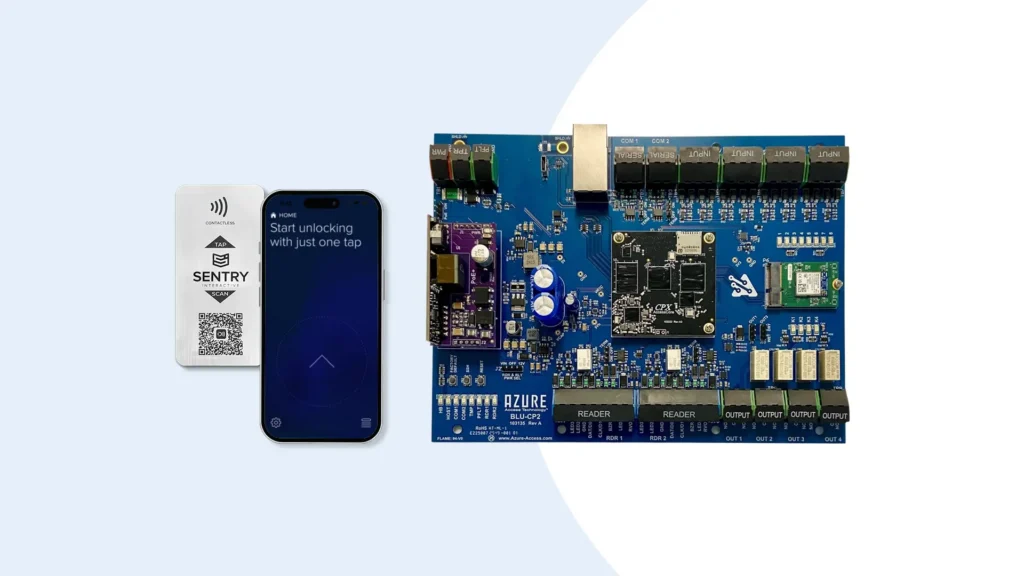
Moving to NFC mobile access has traditionally meant installing mobile-compatible reader hardware at every door, then cabling, configuring and maintaining it. For small and medium-sized businesses (SMBs) without an existing access control system, that reader dependency is often what puts NFC mobile access out of reach.
Sentry Interactive and Azure Access are providing an innovative path to mobile access with fewer hardware dependencies, increased flexibility, and post-quantum security. With Sentry Interactive’s readerless mobile access technology embedded directly onto Azure Access’ BLU-CP Series network controllers, organizations can move to mobile access designed for the post-quantum future using readerless architecture. No dependency on mobile-compatible reader hardware means it can be deployed in days rather than weeks or months and at a cost SMBs can justify.
Here’s how it works and why it matters.
Rethinking the reader at the door
Most NFC mobile access projects start from the same assumption. To accept a mobile credential, every door needs a powered, wired reader that is compatible with that credential type.
That assumption drives much of the cost and time in a deployment. Reader hardware, reader-specific cabling, installation labor and configuration all add up, and they scale with every door. For a smaller organization starting from scratch, they can be the difference between adopting mobile access now and putting it off.
The Azure Access and Sentry Interactive integration removes that dependency. The mobile credential no longer needs a wired reader for it to be authenticated, the user’s mobile phone acts as the virtual reader and authenticator.
How the architecture works
Responsibilities are split cleanly across three roles.
The iOS or Android smartphone carries the NFC mobile credential and acts as the virtual reader. It interacts with a passive, wireless NFC Sentry Smart Access Tile mounted at the access point, so there’s no powered reader to wire in at the door.
Sentry Interactive’s mobile credential layer securely authenticates user identity using post-quantum cryptography over the Sentry Cloud network.
Azure Access’ BLU-CP Series network controllers provide the access control decision layer. With Sentry’s mobile credential layer embedded on the board, the panel checks and validates the credential and controls the door.
Built for new installs and SMBs
The combined offering is designed for new developments and for existing buildings that don’t yet have access control that fulfils expected security standards. It’s especially well-suited to:
- Small and medium-sized businesses that can’t justify upgrading their existing readers on every door to move users to mobile credentials
- New developments, where the design is specified from the start
- Multi-site organizations, where repeating reader upgrade installations at every location multiplies cost and time
Preparing for the quantum threat
The partnership also tackles one of the biggest security challenges facing the access control industry: quantum computing. As quantum technology matures, the conventional encryption that protects today’s credentials could become vulnerable.
That makes credential security a decision to get right at installation, not a problem to fix later. Sentry’s technology combines post-quantum mobile credential cryptography with readerless architecture, so new installs on Azure Access controllers start with future-proofed credential security designed for the threats ahead.
Talk to us about your next deployment
If you’re planning a new install, with an SMB site or a multi-location rollout and want to see whether the Azure Access and Sentry Interactive NFC mobile access solution fits, get in touch with the Sentry Interactive team.