
Why are door readers a security risk in Zero Trust access control?
Zero Trust at the edge starts from an uncomfortable assumption: the door reader is part of the attack surface. It sits in public, it holds or relays secrets, and its wiring runs back to the controller. Readers can be tampered with, spoofed or tapped, and the credentials they read can be cloned.
Most approaches try to upgrade and secure the reader. Sentry Interactive takes a different approach and removes it altogether.
How does Sentry Interactive provide asymmetric mobile access without a door reader?
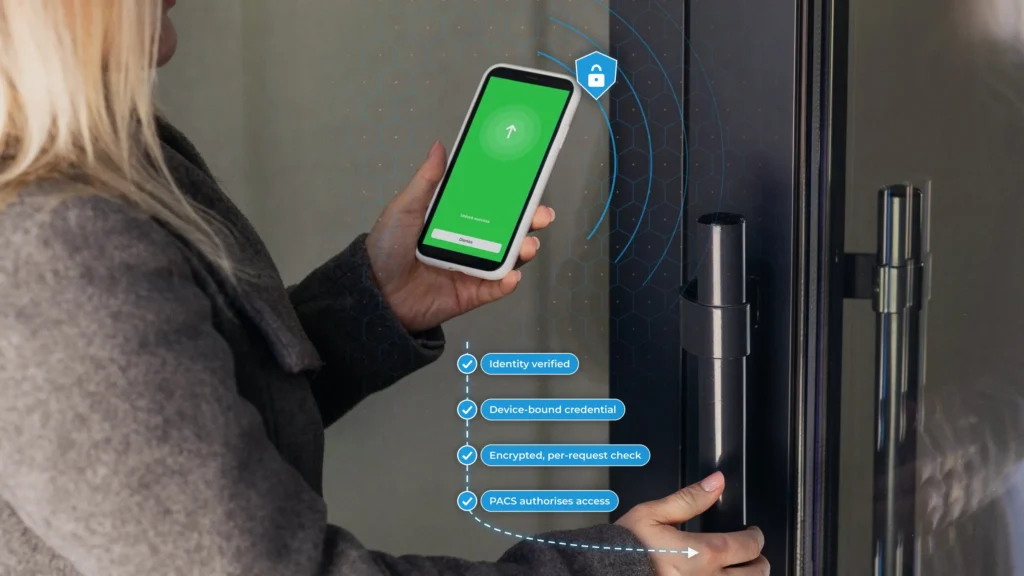
Sentry Interactive’s readerless mobile access technology uses the users mobile phone as a virtual reader, therefore removes the dependency of reader hardware at the door. By removing the need for compatible reader hardware at the door, it removes the attack surface, the threat of readers being compromised, spoofed or tapped.
As for the user’s credential, it is stored securely on the user’s phone every access request is signed using asymmetric cryptography, and nothing is trusted implicitly.
The private key never leaves the phone, so there is no shared secret to steal from the edge device and the public key can be shared to the cloud services to authenticate a user’s identity and access permissions securely. Sentry has been using asymmetric keys for its readerless mobile access technology since 2015, while the access control industry is only now moving away from symmetric credential technology. Now with the threat of quantum computing, Sentry is introducing a path to post-quantum credentials for existing access control ecosystems.
How are readerless mobile access requests verified and revoked?
Nothing is trusted implicitly. Each request is checked in real time against the user’s identity, the site’s access policy and the context of the device making it. Only then is a decision made.
Because each request carries a fresh signature, the credential is never a static secret. There is nothing to clone and nothing to replay. And because trust is evaluated at the moment of access, revoking a credential takes effect instantly, with no cards to collect and no readers to update.
Open standards, and ready for what comes next
Sentry’s technology also supports open credential standards, including Public Key Open Credential (PKOC) and post-quantum, and provides a foundation for cryptographic agility as security requirements evolve.
For organizations looking to extend Zero Trust protections across physical security infrastructure, Sentry presents an opportunity to complement trusted edge devices and communications with cryptographically authenticated credential interactions.
A trusted identity input for Zero Trust architectures
This makes Sentry a natural trusted-identity input to a layered Zero Trust security architecture. It verifies the person and the credential at the very edge, before anything reaches the systems behind it.
The controllers and platforms above receive only authenticated, policy-checked events. The rest of the stack can then do what it does best, working from inputs it can actually trust.
Get in touch with Sentry Interactive to add a Zero Trust mobile credential layer to your existing access control system.